How Do You Know Which Aesthetic Treatments Your Skin Actually Needs?

You look in the mirror and something feels off. Maybe your skin looks a little duller than it used to, or you've noticed a crease between your brows that sticks around even when your face is relaxed. Maybe your cheeks seem flatter than they were a few years ago, or sunspots have started showing up on your jawline. The tricky part isn't wanting to fix it. It's figuring out what "it" actually is, and which of the many aesthetic treatments available today is built to address it.
This is one of the most common places people get stuck. They browse a med spa menu, see a dozen unfamiliar names, and end up either picking something at random or giving up and doing nothing at all. Updated August 2026, this guide walks through how to actually identify what's going on with your skin first, and how that diagnosis (not a guess) is what should point you toward the right treatment, whether that's an injectable, a laser, or simply a smarter skincare routine. If you're in San Diego, California, and searching for a starting point that makes sense for your specific face, this is meant to be that starting point.
Why Guessing at a Treatment Rarely Works Out
Aesthetic concerns often get lumped together under vague words like "aging" or "dullness," but they come from very different sources. Fine lines caused by repeated facial movement are not the same problem as textural roughness from years of sun exposure. Hollowness under the eyes from volume loss is not the same as puffiness from fluid retention. Treating the wrong root cause usually means spending money on something that was never going to fix what actually bothers you.
This is why so many people try a product, a device, or a treatment they heard about from a friend, only to feel disappointed a few months later. The friend's skin and yours may look similar at a glance, but the underlying cause of what you're each seeing can be completely different.
Is It Wrinkles, Texture, or Volume? Here's How to Tell
A simple way to start sorting your concern is to ask three questions.
Does it show up only when you make an expression? Lines that appear when you smile, frown, or raise your eyebrows, and soften when your face is at rest, are usually expression lines. These respond well to a treatment like Neurotox, which relaxes the specific muscle movement causing the crease.
Does your skin feel rough, uneven, or discolored even when your face is still? That points toward a texture or pigment issue, often from sun exposure, old acne marks, or general skin aging. This is where laser and light based treatments come in, rather than an injectable.
Has an area of your face lost its shape, looking flatter, hollow, or less supported than it used to? That's usually volume loss, which is a structural change rather than a surface one. This is where a filler is typically the more appropriate option.
Most people actually have some combination of these three things happening at once, which is exactly why a single treatment rarely solves everything and why a proper assessment matters so much.
When Should You Consider an Injectable Treatment?
If your main concern is dynamic lines, like the "elevens" between your brows, crow's feet, or forehead lines that deepen with expression, an injectable is generally the more targeted solution. Neurotox works by temporarily reducing the muscle activity that creates those creases, which is why it's most effective on lines caused by repeated movement rather than lines caused by skin damage or volume loss.
If instead your concern is more about shape and support, such as flattened cheeks, thinning lips, or a jawline that's lost definition, HA filler is designed to restore volume and structure in a way that a muscle-relaxing treatment simply isn't built to do. Filler adds back what's been lost, while Neurotox limits movement that's creating a line. They solve two different problems, and many people benefit from both, but only once it's clear which one is actually driving their concern.
When Is a Laser or Light-Based Treatment the Better Fit?
Texture, tone, and pigment issues live on a different layer of the skin than expression lines or volume loss, which is why they usually call for a different kind of tool entirely.
If your biggest frustration is sun damage, uneven tone, visible redness, enlarged pores, or an overall lack of glow, a treatment like Alma Hybrid Skin Rejuvenation is designed to work on that surface and mid layer of skin to improve tone and texture over a series of sessions. It's a strong option for people dealing with sun damage or general skin aging rather than deep wrinkles or lost volume.
For more focused concerns, such as fine lines around the eyes, mild skin laxity, or an overall tired appearance without deep creasing, ClearLift Skin Resurfacing offers a gentler, no downtime approach that can be layered into a broader plan.
If discoloration, such as sunspots, redness, or visible small vessels, is the main issue, a light based treatment like DYE-VL is built specifically to target that kind of pigment and vascular concern, which is a very different job than smoothing texture or softening a wrinkle.
And if unwanted hair, rather than skin tone or texture, is what's bothering you, that's a separate concern altogether, one that laser hair removal is specifically built to address, working on the hair follicle itself rather than the surface of the skin.
What If You're Not Sure Which Category You Fall Into?
This is the most common situation, and it's completely normal. Skin concerns overlap, lighting in your bathroom mirror isn't the most accurate diagnostic tool, and it's genuinely hard to self-assess something you look at every single day.
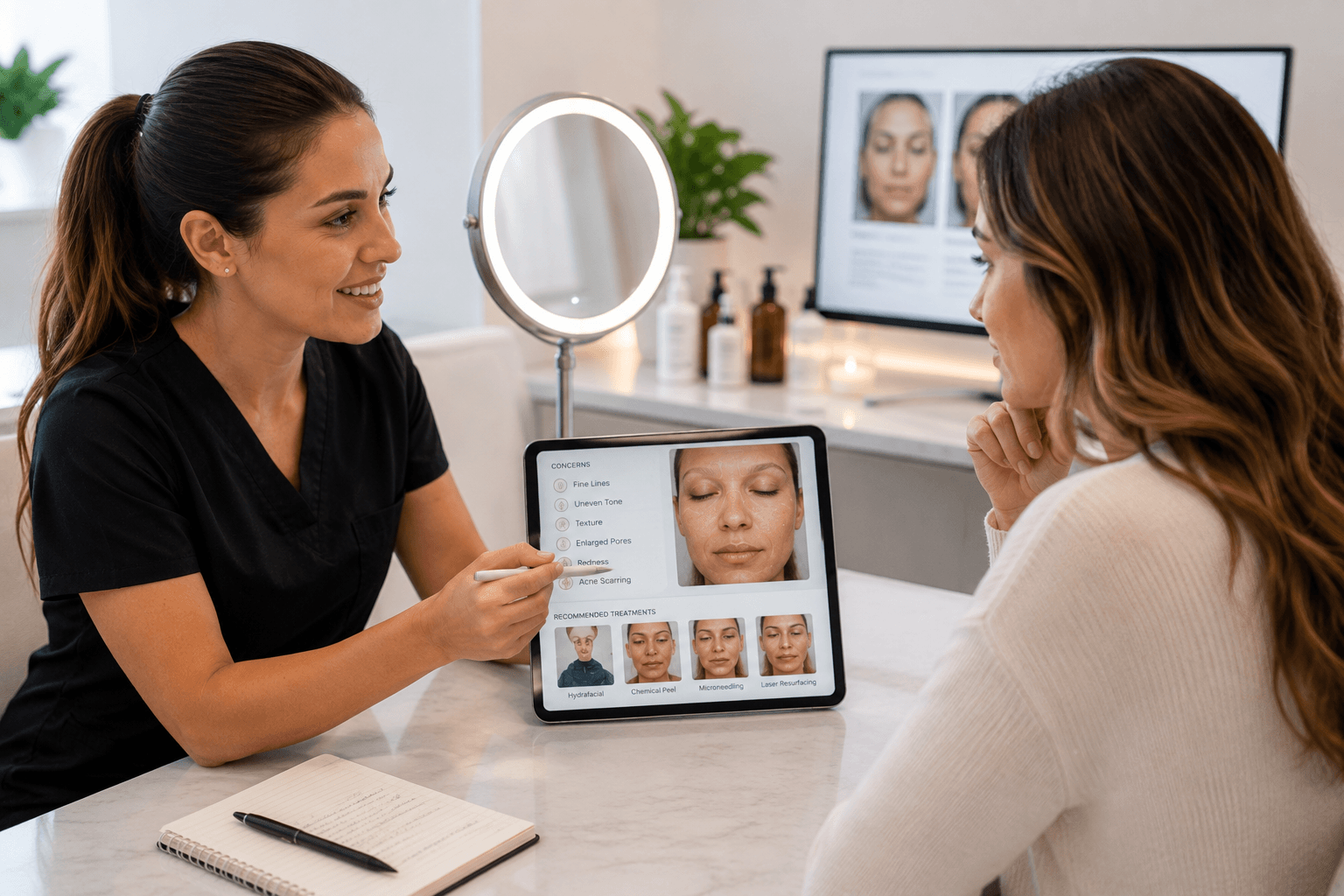
This is exactly the gap that a proper skin assessment is meant to close. Rather than guessing, starting with Alma iQ Skin Analysis gives a detailed, magnified look at what's actually happening in your skin, including sun damage, pore congestion, pigment irregularities, and hydration levels that aren't always visible to the naked eye. Instead of choosing a treatment first and hoping it matches your concern, the analysis flips the order: understand the skin first, then match the treatment to it.
This approach tends to save people both time and money, since it prevents the common cycle of trying one thing, not seeing the results you hoped for, and then trying something else.
What Does a Personalized Consultation Actually Involve?
A consultation at a med spa should feel more like a conversation than a sales pitch. Expect to talk through your history, your goals, and what specifically bothers you day to day, whether that's a specific line, an overall texture issue, or a combination of concerns you haven't been able to put into words.
From there, a visual or device-based skin assessment, such as Alma iQ, can help confirm what's happening beneath the surface. Based on that combined picture, from your goals to a clearer read of your skin, a plan can be built that might include one treatment or a thoughtful combination, phased over time rather than everything at once.
This is a very different experience from browsing a treatment menu blind, and it's the approach behind Serenova's broader philosophy on choosing the right path forward, which is covered in more detail in this related guide on choosing aesthetic services in San Diego.
What Should You Expect After Treatment Begins?
Timelines vary depending on what's being addressed. Neurotox results typically show up within days and settle in over one to two weeks. Filler results are often visible almost immediately, with any minor swelling resolving within days. Laser and light based treatments tend to work more gradually, with texture and tone improvements building over a series of sessions rather than all at once.
None of these treatments are meant to be a one-time fix that lasts forever. Skin continues to age, sun exposure continues to happen, and muscle movement never stops, which is why most people settle into a maintenance rhythm once they find the combination that works for their face.
Frequently Asked Questions
How do I know if my skin issue needs a laser treatment or an injectable? If the concern shows up mainly with facial expression, like a crease between the brows, an injectable such as Neurotox is usually more appropriate. If it's about tone, texture, or pigment that's visible even when your face is at rest, a laser or light based treatment is typically the better match.
Can aesthetic treatments help with both wrinkles and sun damage at the same time? Yes. Because these are two different concerns, it's common to combine an injectable for expression lines with a laser or light based treatment for tone and texture, once both concerns have been properly identified.
What is Alma iQ Skin Analysis and do I need it before booking a treatment? It's a detailed skin assessment that looks beneath the surface to identify sun damage, pigment, pore congestion, and hydration levels. It isn't a requirement, but it's a helpful first step for anyone unsure which aesthetic treatments would actually address their concern.
Is filler or Neurotox better for fine lines around the mouth or eyes? It depends on whether the lines are caused by muscle movement or by lost volume and skin laxity. This is something a consultation can help clarify, since the two causes call for different treatments.
Do I need to travel to San Diego, or is this available closer to La Mesa? Serenova Med Spa serves patients throughout San Diego, California, with La Mesa also served as part of the broader service area, so you can get a proper assessment without much added travel.
How often will I need aesthetic treatments once I start? This depends entirely on the treatment and your goals. Neurotox typically needs refreshing every few months, filler can last longer, and laser or light based treatments are often done in a series before shifting into occasional maintenance sessions.
So, Ready to Stop Guessing and Start Glowing?
Trying to self-diagnose a skin concern from a bathroom mirror is a bit like trying to fix a car engine by listening to it idle. You can tell something's not quite right, but you need the right tools to know exactly what it is. A proper skin assessment takes the guesswork out of the equation and points you toward the aesthetic treatments actually built for your concern, whether that's an injectable, a laser, or a combination of both.
If you're in San Diego, California, or nearby in La Mesa, and you're ready to finally understand what your skin needs instead of guessing, book a consultation with Serenova Med Spa and let's build a plan around your actual skin, not someone else's. You can also learn more about our approach on our homepage or meet the team behind your care on our our team page.